Formerly Seattle Smile Designs & Bellevue Center for Orthodontics
Refer a PatientDoes Your
Child Snore?
Snoring and mouth breathing in growing children can indicate an underlying problem.
Chronic mouth breathing in growing individuals alters the way their upper and lower jaws grow. Such abnormal growth patterns in the jaws may necessitate surgical correction if not diagnosed and treated early. Mouth breathing may also indicate an airway obstruction, leading to poor sleep quality and subsequent problems with neurocognitive development. If caught and treated early, we have the ability to alter the skeletal growth trajectory and make tremendous positive changes.
Mouth breathing may indicate an airway obstruction, leading to poor sleep quality and subsequent inadequate neurocogntive development and whole body development.
Normal skeletal and dental growth of the face and jaws depends on even pressure from the lips and cheeks on the outside, and from the tongue on the inside of the mouth. Children with nasal obstruction such as asthma, allergies, deviated septum, and large tonsils and adenoids are forced to breathe through their mouths. If a growing child has his or her mouth open the majority of the time, the lips are not together and the tongue is not exerting pressure on the upper jaw and teeth. This leads to an open bite skeletal pattern, a long lower face, and an underdeveloped upper jaw. Other contributing factors can be a tethered tongue (“tongue tied”) where the tongue cannot rest in the roof of the mouth, preventing normal development of the upper jaw. Tethered tongues can also block the posterior airway because the child cannot position the tongue up and forward – out of the back of the throat.
Signs to look for in growing children
A tethered tongue (tongue-tied) prevents the tongue from resting in the roof of the mouth – preventing normal growth and development of the upper jaw.
Signs of an underdeveloped jaw:
- Dry and chapped lips
- Opened-mouth posture while the child is sitting still (inability to keep lips together)
- Chronic runny nose and or allergies
- History of chronic ear infections
- Dental crossbite
- Dental crowding and/or delayed eruption of adult teeth
- Red or swollen upper gums
- Always eats with mouth opened
- Anterior open bite (front teeth do not overlap)
- Underbite or overbite
Signs of a possible tongue tie:
- History of difficulty breast feeding
- History of speech therapy
- Hsitory of difficulty swallowing or extreme food preferences
- Inability of child to put tongue to roof of mouth comfortably
A dental crossbite is a sign that the tongue is not resting in the roof of the mouth. If not treated early, a small upper jaw may lead to incorrect or even blocked eruption of adult teeth and a compromised airway.
Signs of obstructed airway:
- Have you heard your child snore?
- Have you heard your child stop breathing?
- Have you heard your child grind his or her teeth?
- Does your child toss and turn through the night?
- Is there a history of bed wetting?
- Do you observe daytime sleepiness?
- Does your child have morning headaches?
- Do you observe hyperactivity and/or an inability to pay attention to tasks?
The
Next
Steps
Sleep Disturbances Scale
The questionnaire below will allow your orthodontist to have a better understanding of the sleep-wake rhythm of your child and of any problems in his/her sleep behavior. Try to answer every question; in answering, consider each question as pertaining to the past 6 months of the child’s life. Thank you very much for your help.
Sleep Disturbances Scale for Children Questionnaire
Please bring the questionnaire in with your child for an examination. We will help determine the causes of the problem and direct you to the proper resources.
Possible next steps may include:
- A pediatric sleep study
- Collaboration with a pediatric ENT if tonsils and adenoids need to be removed
- The correction of the “tongue tie”
- The help of a myofunctional therapist – a specialist who helps re-train the tongue
- A maxillary expander: to make room for the tongue, to correct the jaw growth, to allow the adult teeth to erupt normally, and to increase nasal airway space.
If we diagnose and correct airway problems early in growing individuals, we can help change their growth trajectory – helping prevent adult sleep apnea, preventing the need for jaw surgery later in life, and creating an environment for the normal growth and development.
Our goal is a beautiful smile at two locations

Seattle Orthodontics
---509 Olive Way Suite 840
Seattle, WA 98101
Text or Call: (206) 623-2192 | Email
Office Hours
Mon - Wed, 8:00 AM - 4:30 PM
Thu, 9:00 AM - 12:00 PM
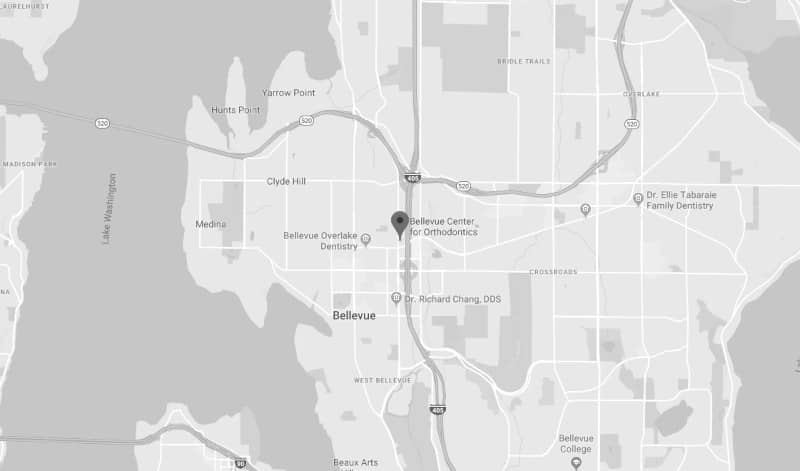
Bellevue Orthodontics
---1200 112th Ave NE B-200
Bellevue, WA 98004
Text or Call: (425) 453-0551 | Email
Office Hours
Mon - Thurs, 8:00 AM - 4:30 PM